If you sell professional audio as an OEM wholesaler, “one mixer” is rarely a business model. The business model is a lineup: an entry tier that converts volume, a mid tier that funds your growth, and an install/engineering tier that anchors long-term projects.
The mistake many wholesalers make is starting with specs. The correct starting point is margin architecture: what price bands you want to own, what channel customers can reliably sell, and what operational risk you can support (support tickets, returns, training load).
This article shows a practical structure you can apply immediately: a 3-tier lineup that maps to real buyer behavior, based on the X/MD/T family concept (desktop manual fader → desktop motorized fader → rack integration control).
Step 1 — Define the three purchase contexts (not “three products”)
Most demand for digital mixers comes from three contexts:
Small venues & “I just need it to work” users
They want an easy upgrade from analog, simple setup, and fewer external processors.
Rental / live events / multi-scene operations
They care about scene recall workflow, fast changeovers, and clear control under pressure.
Fixed installation & system integration
They care about rack rooms, centralized control, distributed zones, and reliability over long uptime.
The same physical features can be “nice to have” in one context and “deal-breaker” in another. Your lineup should make that difference obvious.
Step 2 — Build your lineup around “control style” (how the customer actually uses the mixer)
A clean, buyer-friendly structure is:
Tier A: Desktop + manual faders (X concept)
Easy for analog users to adopt; touchscreen makes settings visible; core processing and effects are built-in.
Tier B: Desktop + motorized faders (MD concept)
Adds professional workflow for rental/live: motorized faders for scene recall, DCA grouping, lock functions, quick mute, footswitch, tap tempo — features that reduce show risk.
Tier C: Rack + knobs + touchscreen (T concept)
Built for integration: centralized control in a rack, suitable for multi-function halls, meeting centers, schools, venues, and commercial zones.
This “control style” framing is not marketing fluff—it directly reduces returns. Buyers get what they expect.
Step 3 — Make “core capabilities” consistent across the lineup (reduce training + support cost)
A high-performing OEM lineup has a consistent backbone:
(A) Full processing on every channel
HPF/LPF, PEQ, compressor, gate, phase inversion—standardized across the series.
(B) Full processing on AUX and main outs
Crossover, PEQ/graphic EQ, compression, delay—so the mixer can replace external racks in many projects.
(C) Built-in stereo FX + repeatable presets
Dual stereo FX engines with user presets reduce “operator skill” as a risk factor and speed up deployment.
(D) Consistent control platform: 7" capacitive touchscreen
A 7" 1280×800 capacitive screen enables complete on-console setup (no dependency on phones/tablets).
(E) Browser-based remote control (HTML5) with built-in Wi-Fi hotspot
Cross-platform web control, multi-device collaboration, optional external router support for large venues. This consistency is what makes OEM scaling possible: you can train once and sell many.
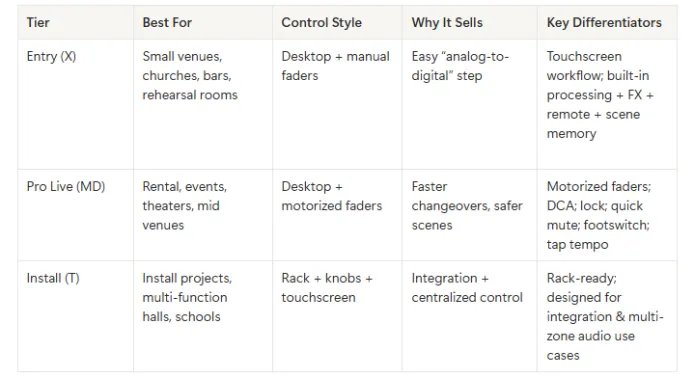
Step 4 — Use a simple lineup table your buyers immediately understand
Below is a buyer-facing table you can reuse in your catalog, website, and sales conversations.
Step 5 — Don’t overpromise recording: sell what exists + what’s planned
Recording is a common trap. If you say “multitrack” but the buyer expects it now, you create refunds.
A clean OEM-safe statement is:
Current generation: Stereo 2-track recording/playback; stereo recording to USB drive; stereo USB audio interface for recording/playback/streaming.
Roadmap: Multitrack capability is planned and will be opened progressively with future hardware/firmware iterations.
This does two things:
protects you from misrepresentation, and
creates a long-term upgrade story for your brand.
Bottom line
If you are an OEM wholesaler serving the US and Argentina markets, the fastest path is not “one best mixer.” It’s a tiered lineup with consistent core capabilities, plus clear differentiation by control style and buyer use case.
Soft CTA: If you want the exact lineup template (tiers + recommended price-band positioning + catalog structure), request our catalog + price-band positioning sheet.
Email: [email protected]