

PROFESSIONAL AUDIO SOURCING
By Anthony Wu, Founder of ELEGAUDIO
Before placing a professional audio order with a supplier in China, confirm four things: whether the products fit your market, how the sample and bulk order will be matched, whether the equipment works together, and whether the documentation matches the version you will receive.

DG-15 wireless microphone system from the ELEGAUDIO catalogue. Confirm the exact version and frequency band for each order.
Unit price matters when comparing quotations. So do unsold inventory, inconsistent product versions, compatibility problems, returns and repairs. Each can affect the actual return on an order.
Defining the intended use, product version, verification evidence and delivery requirements before increasing your purchasing volume can help you identify problems earlier and make better-informed sourcing decisions.
I’m Anthony Wu, founder of ELEGAUDIO. Through my work in the professional audio supply chain in Enping, Guangdong, I have come to place increasing importance on explaining what has been confirmed about a recommended product and what still needs to be verified.
Different buyers can have different priorities, even when sourcing the same type of equipment.
ELEGAUDIO’s business covers wireless microphones, in-ear monitoring systems, audio mixers, power amplifiers, loudspeakers and related accessories. We aim to start with your sales market, channel and intended application, then help identify candidate products and the questions that need checking. The specific scope of product selection, customization and delivery support should be confirmed for each product and project.
A product’s popularity on a particular platform can be useful context, but it does not establish that the product will suit your sales channel. Target users, retail prices, operating environments, after-sales arrangements and local requirements can all change the outcome.
We also operate our own retail business and pay attention to user reviews, return feedback and problems encountered in use. This experience is useful for identifying more specific questions to test. If customers find a connection process confusing, for example, the manual, connector labels and included accessories deserve closer examination.
Retail feedback should be tied to the relevant market, time period and product version. Results from one market should not be treated as a general conclusion or as a forecast of another buyer’s B2B sales.
Before working with us, you can also ask whether our retail business and the products you are considering overlap in market, model or sales channel. Brand, channel and any territorial arrangements should be discussed separately and agreed in writing. Exclusivity or territory protection should never be assumed.
Once a sample passes testing, the agreed details still need to be carried through to the order. Changes to the model, hardware or software version, frequency band, connectors, power supply, accessories or packaging can affect operation and after-sales support.
Useful references include current product documentation, photographs of the actual product, sample test records, and specifications and packing lists confirmed by both parties. Depending on the order, also agree on retained reference samples, inspection items, acceptance criteria and the process for approving changes.
The aim is to reduce the risk of differences between the sample and the bulk order. Passing a sample test does not replace inspection of the production batch.
Adding models is only the first step in expanding a product range. Microphones, mixers, amplifiers and loudspeakers also need to be checked together for connections, signal levels, power requirements and intended operation.
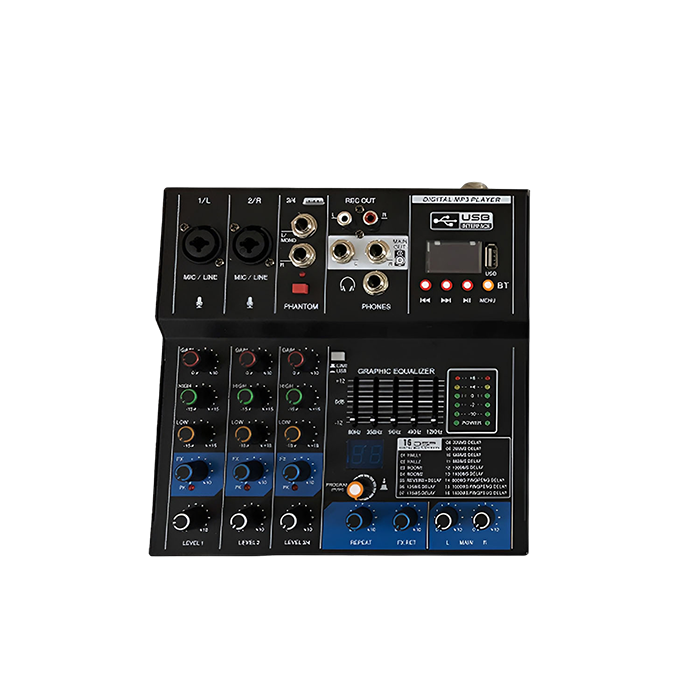
GL-4USB mixing console from the ELEGAUDIO catalogue. Check the actual connectors, signal levels and power requirements of your intended equipment combination.
When multiple wireless systems will be used together, consider the destination country’s spectrum rules, the local radio-frequency environment and the intended conditions of simultaneous use.
Start with a simple equipment connection diagram, then check connectors, cables, accessories and operating steps. If you plan to sell a bundle, test the exact combination you intend to offer and record the conditions and results. This helps identify combinations worth evaluating further and those that need adjustment.
Preparing a product for sale requires accurate specifications, manuals, packaging labels and any required compliance documentation. Images, connectors, functions and accessories shown in those materials should match the version actually delivered.
For OEM or ODM projects, confirm the customization scope, costs, approval stages and each party’s responsibilities in advance.
When reviewing certificates or test reports, check the applicable model, version, standards and destination requirements. A certificate name or logo alone is not enough. Wireless frequency bands and operating conditions also need to be checked for the country where the products will be sold.
Where confirmation is needed from the local importer, a compliance adviser or a testing organization, assign responsibility and agree on timing. Resolve these questions before they become a problem at shipment or product listing.
Begin with the sales country, main channel and priority product categories. Then discuss the application, target price range, expected purchasing volume and current concerns.
Review the reasons for recommending each candidate model alongside the information already available and any gaps. This provides a basis for deciding which products should move to the sample stage.
Before testing, agree on the sample version, test items and required documentation. Carry out verification under the relevant practical conditions.
Check frequency bands, compatibility, certification requirements and customization requirements individually. Be clear about missing documents, tests still to be completed and any costs involved. The results should inform whether to proceed; they should not be presented as a guarantee of sales performance.
The formal order should specify the product version, specifications, accessories, packaging, quantity, price, delivery schedule and trade terms. It should also cover inspection, change approval, shipping documents and after-sales procedures.
For after-sales support, confirm the information needed to report a problem, arrangements for spare parts or repairs, and responsibility for the costs. Execution should follow the order and agreements confirmed by both parties.
If you are considering a wireless microphone system, the following questions are a practical starting point. This is a procurement checklist, not a test result for a specific model.
Putting these questions into a checklist makes it easier to compare different options, even if you ultimately choose a different model.
Check market fit, the agreed product version, sample and batch inspection arrangements, compatibility, destination-country requirements and launch documentation. Put the order specifications, delivery terms, change approval process and after-sales responsibilities in writing.
No. A sample is a reference for the agreed version and test results. The bulk order still needs an agreed inspection approach, acceptance criteria and a process for approving any changes.
No. Check the exact frequency band, intended use and any licence or operating conditions in the destination country. The conditions for using multiple systems together also need to be evaluated.
Retail feedback can help identify issues worth testing, but it does not establish likely sales in another market or channel. Consider the market, time period, product version, target users and after-sales conditions behind the feedback.
Confirm the customization scope, product version, costs, approval stages and responsibilities. Check that specifications, manuals, packaging and required compliance documents will match the delivered product. Any brand, channel or territorial arrangements should be agreed separately in writing.
If you are planning your next purchase, start by sharing:
For example: “Brazil / professional audio dealers / wireless microphones.”
With these details, we can discuss product directions worth exploring and the questions to verify first. The next step may be to gather more information, test samples or prepare a quotation.
We aim to be a trusted extension of your team in China. That starts with explaining what is confirmed, making unresolved questions visible and moving through the sourcing process step by step.
Anthony Wu and the ELEGAUDIO team
Email: anthony@elegaudio.com
WhatsApp / WeChat / Mobile: +86 13822326488