


The XR18 is a solid unit, but the complaints I hear most often from users looking to upgrade fall into three categories:
The XR18 is completely screenless. Everything depends on the X Air app running on an external device. If that app breaks after an iOS or Android update — which it has, repeatedly, for many users — you lose wireless control entirely until a patch comes out. You're essentially renting your control interface from Behringer's app development schedule.
In rental and live environments, "which tablet do you have, and is the app updated?" becomes a pre-show checklist item. That's friction that shouldn't exist.
The XR18 is capable, but users moving into more demanding installs — multi-zone venues, houses of worship, fixed installations — often find themselves wanting crossover, per-output delay, and anti-feedback on the buses, not just the inputs.
More input headroom — if you're running 18 channels now, you'll want 26–32 when your setup grows
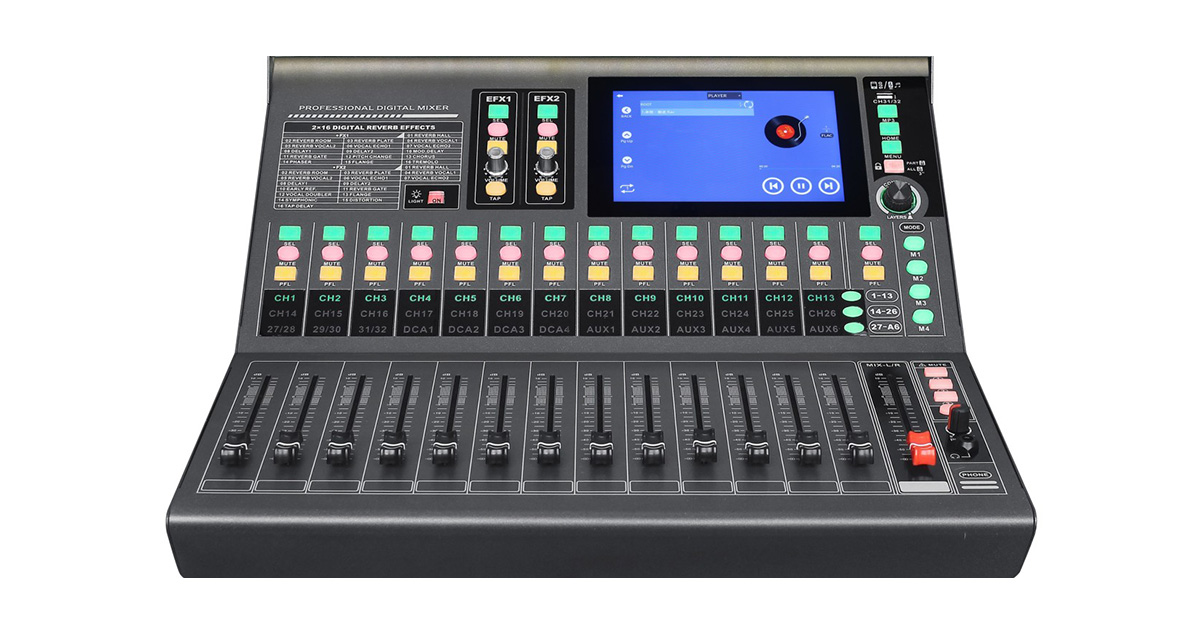
I'll be transparent — I work at Elegant Audio, and we manufacture the MX3210, which was designed specifically around the gaps the XR18 leaves open.
It has a 7-inch built-in touchscreen, so you can walk up and mix without any external device. For wireless control, it uses a browser-based interface — open Chrome or Safari on any phone, type one IP address, and you're in. No app. No version conflicts.
On the processing side: all 32 input channels have HPF/LPF, 4-band PEQ, compressor, noise gate, and phase. Every output bus has crossover, EQ, compression, delay, and 3-stage anti-feedback frequency shifting — which is the feature XR18 users most often say they wish they had.
It also has Bluetooth, USB recording, and RS485 for central control system integration — useful if you're doing fixed installs.
Full details here if you want to look at specs: Not every digital mixer dares to offer an MOQ as low as 10, let alone three tiers of OEM solutions.
Midas MR18 — essentially the XR18 with better preamps, so you keep the same limitations
If your main frustrations with the XR18 are the app dependency and the lack of a screen, the MX3210 addresses both directly. If your priority is absolute top-tier preamp quality and budget isn't a concern, the Allen & Heath SQ series is hard to beat.
Happy to answer any specific questions about the MX3210 or the comparison in the comments.
Anthony Wu — CEO, Elegant Audio (Enping, Guangdong, China). We manufacture professional audio equipment for distributors and rental companies worldwide.