


Direct answer: Control digital mixer quality by linking the approved requirements, the exact sample version, repeatable checks and the shipment release record. For each required function, record the setup, expected result, observation, verdict and evidence. Keep pass, fail, not tested and not applicable separate. Approve changes and close mandatory issues before release; a successful demonstration alone is not a complete acceptance record.
For distributors, importers, rental buyers and system integrators. A digital mixer can appear satisfactory in a short demonstration while the buyer and supplier still disagree about what was accepted. A useful checklist makes the configuration, conditions and decision traceable. It separates a demonstrated feature from an assumption and a sample decision from shipment release.
By Anthony Wu · ELEGAUDIO · November 20, 2026
This guide provides a buyer-controlled acceptance method. The proposed checks are not a claim that ELEGAUDIO has already performed them on a named unit or shipment. Technical limits and commercial inspection scope must be agreed for the actual project.
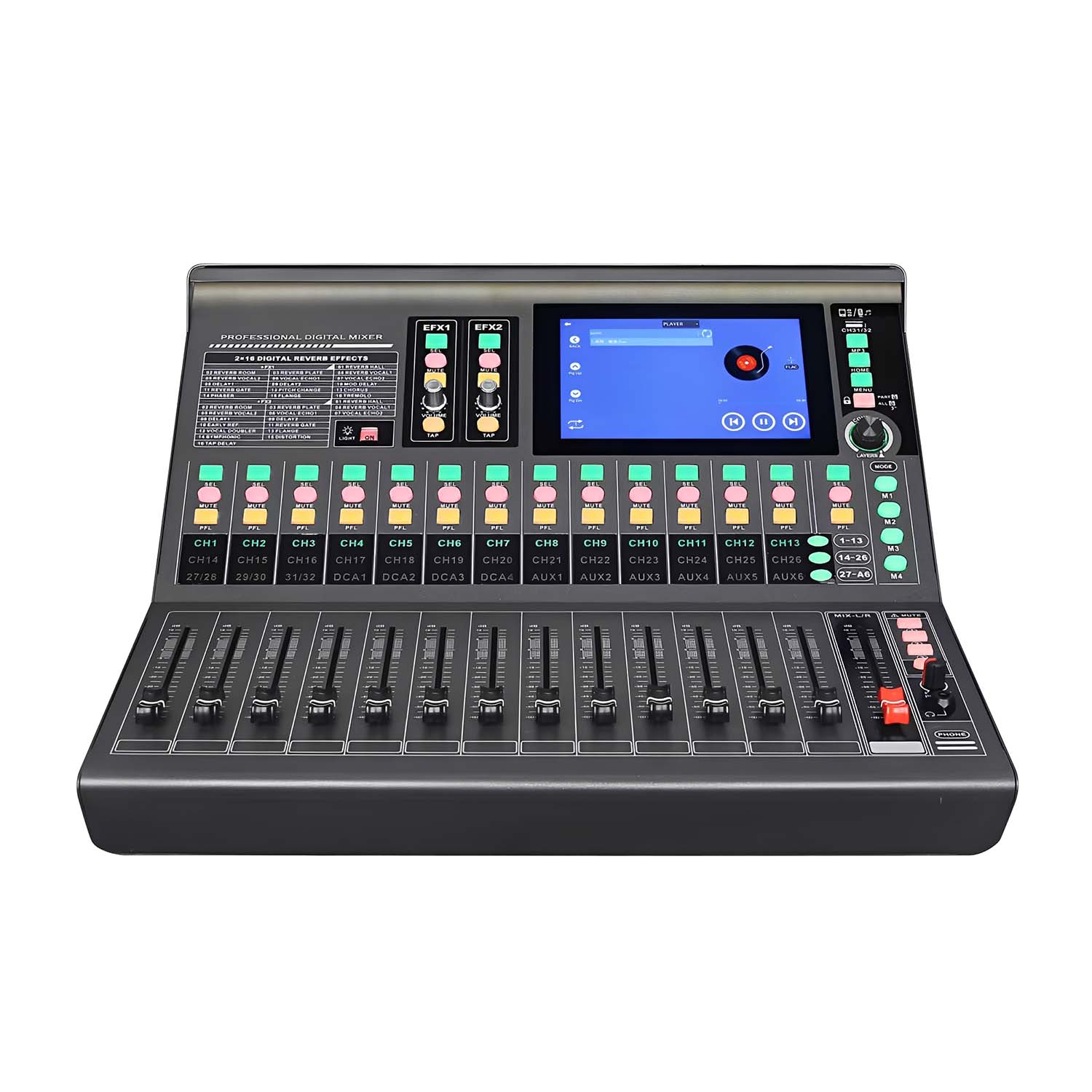
MX series · MX3210. Official product photograph, not a photograph of an inspection or a test result. View MX3210 product details →
The goal is an evidence record that lets a buyer understand what was tested, under which conditions and why release was or was not approved. Separate sample acceptance, change review and shipment inspection. Each answers a different question.
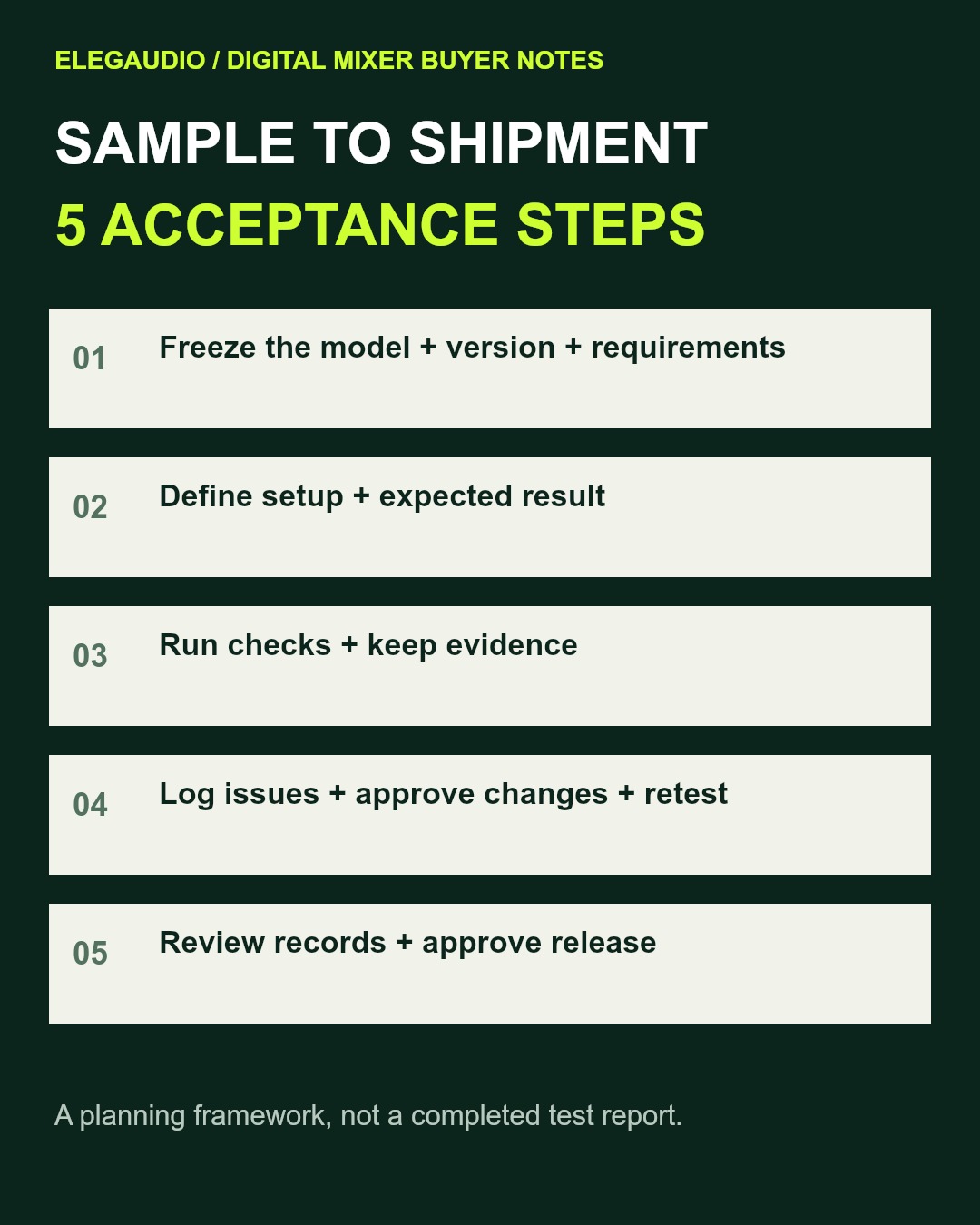
Use a version-specific record from requirements through release. This diagram explains a method, not a completed inspection.
Start with the intended application and a list of mandatory functions. Link each requirement to a current model document or an agreed demonstration. Record hardware and firmware separately, and identify the sample. Obtain clarification where a requirement is not established. Use the DAM / MDX / T / MX digital mixer selection guide before defining the acceptance scope.
Write down the signal source, cables, ports, routing, levels, connected devices and software versions needed to reproduce the check. Specify the expected behavior and who will judge it. Use the supplied operating instructions and safe listening levels; electrical safety or internal service checks belong with qualified personnel under the appropriate procedure.
Test the actual workflow, not just whether a menu opens. Keep an observation separate from the verdict: “destination B changed when only mix A was adjusted” describes a result; pass or fail depends on the agreed criterion. Attach photographs, short recordings, settings references or other agreed evidence where useful.
Give every issue an ID, affected version, reproduction steps, severity or project impact, owner and resolution decision. A firmware update creates a new version reference. Preserve the original result and record the retest separately. Review related functions where the change could affect them rather than simply overwriting the first verdict.
Record the approved sample/configuration and which changes require buyer approval. Agree the shipment inspection coverage, evidence and release reviewer before dispatch. A sample pass is one input; it does not automatically establish every unit, every accessory or every later firmware build. Release only when mandatory conditions and required records are satisfied.
| Check area | Suggested method and evidence | Acceptance decision to agree |
|---|---|---|
| Identity and supplied configuration | Record the model, serial or sample ID, hardware revision, firmware build, manual revision and agreed accessories. Photograph identifiers where available. | The supplied configuration matches the agreed reference; any difference has an explicit review decision. |
| Exterior, controls and packing contents | Check the received unit against the packing list. Record visible damage, connectors, knobs, faders, display condition and included power/accessory items. | Contents and condition match the agreed list and inspection criteria; discrepancies remain visible in the record. |
| Required input-to-output paths | Using the agreed sources and safe listening levels, trace each required input type to the intended main and other destinations. Identify the port, channel and routing used. | Each required path gives the expected result for the documented setup. Do not infer an untested path from a similar one. |
| Independent monitor mixes | Where required and supported, change one monitor mix while observing the others. Record bus assignments and physical destinations separately. | The required mixes can be controlled independently in the approved configuration. A DCA alone is not another audio mix. |
| Control workflow and scene handling | Perform the intended operator tasks. If scene storage/recall is required, save an agreed setup, make specified changes and recall it. Note any recall scope or exclusions. | Observed settings and behavior match the agreed recall scope and operating instructions. |
| Recording, playback or remote operation | Test only the functions needed and documented for this model. Record connected device, software/app version, connection method and settings. | The named workflow operates under the agreed conditions. One successful setup does not establish universal compatibility. |
| Repeatability and issue reproduction | Repeat critical steps under the agreed conditions. For a fault, record a minimal repeatable sequence and the affected version. | Required results are repeatable under the defined conditions, or the deviation is logged for review. This is not a lifetime reliability claim. |
| Labels, documents, accessories and shipment identity | Compare the proposed shipping configuration, labels, artwork and packing list to the approved reference. Check required document coverage for the supplied version. | The release reviewer can trace what was approved to what is being supplied; unresolved mandatory differences prevent approval. |
Use four explicit result states. Pass means the observed result met the agreed criterion; fail means it did not; not tested means no completed result is available; not applicable means the check does not belong to this configuration, with the reason recorded. Do not count an untested mandatory item as passed.
Define the release rule in advance. For example, a project can require every mandatory check to be passed, all required records present and no unresolved mandatory deviation. Any exception needs a named reviewer and a recorded scope decision. This example is a planning rule, not an undisclosed ELEGAUDIO quality statistic.
Project / destination / buyer:
Sample or shipment reference / inspected unit IDs:
Model / hardware revision / firmware build:
Manual, specification and approved-reference IDs:
Check ID / requirement / mandatory or optional:
Setup: source, ports, routing, levels, connected versions:
Expected result / acceptance criterion:
Observed result:
Verdict: pass / fail / not tested / not applicable:
Evidence reference / reviewer / date:
Issue ID / owner / action / due date:
Retest version / result / evidence:
Release decision / approver / unresolved conditions:
Illustrative record, not an actual test report: QC-04 concerns independent mixes. The plan names monitor destinations A and B and the documented routing. The expected result is that adjusting A leaves B unchanged. The reviewer records the observed behavior and evidence before entering a verdict. A model without the required independent paths cannot be approved for that requirement merely because its main output works.
Read the digital mixer AUX, bus and DCA guide when defining the monitor test. For private-label projects, use the digital mixer OEM/ODM approval process to connect artwork and configuration decisions.
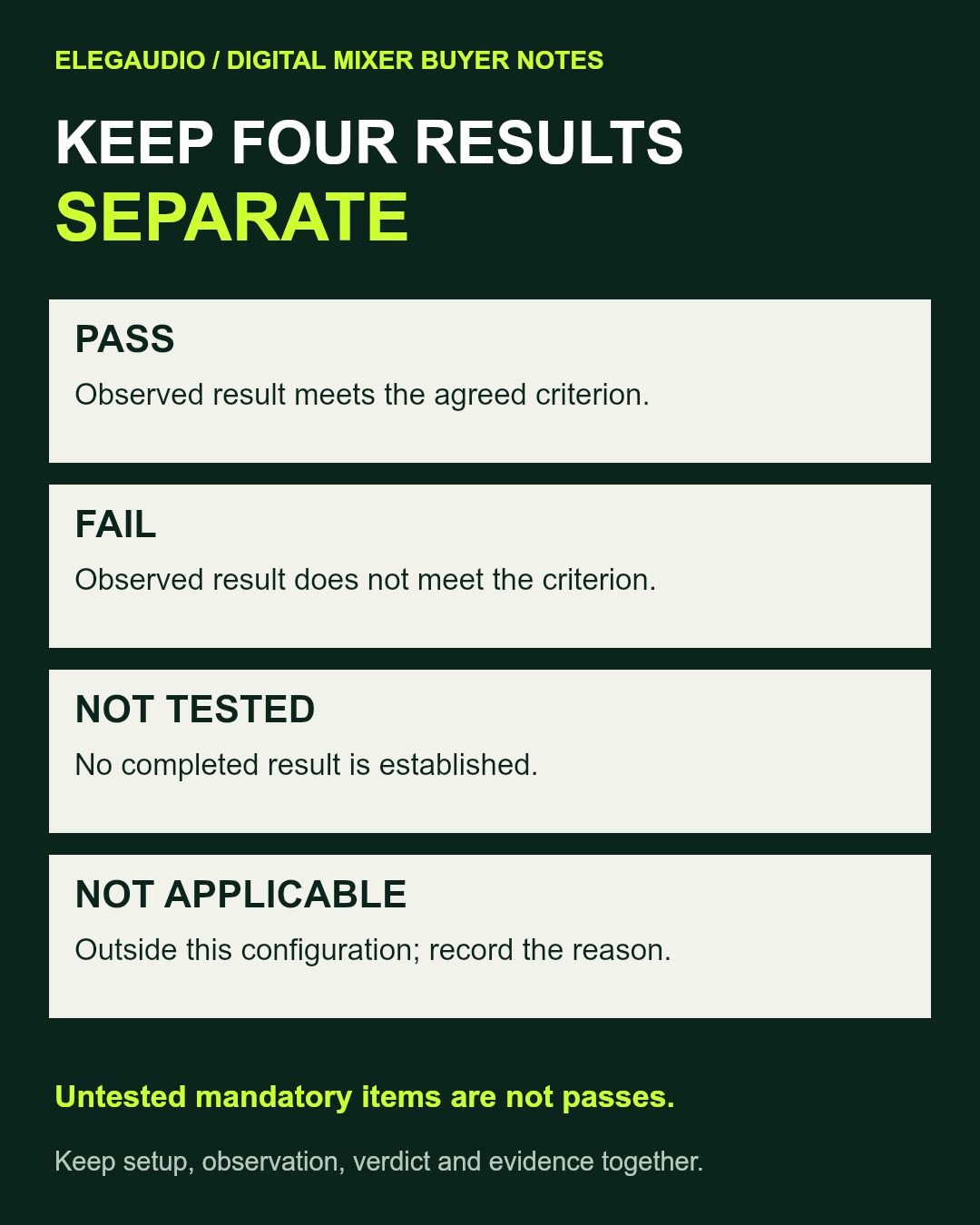
Keep missing evidence visible; an untested mandatory item is not a pass.
No. A sample result describes the tested unit and conditions. Agree the production reference, change control, inspection coverage and release criteria separately. Record which units and functions were actually inspected.
Define duration and conditions from the project requirements and an agreed test plan. There is no universal duration established by this article. A short functional check should not be presented as proof of long-term reliability.
Fail means an observed result did not meet an agreed criterion. Not tested means the check has not been completed or the result cannot be established. Neither should be silently converted to pass.
The record format can be reused, but each test must match the exact model and documented functions. Mark irrelevant optional checks not applicable with a reason; do not assume features transfer between series.
Send the destination market, proposed model and version, application, required signal/control workflows, quantity and mandatory acceptance criteria. Ask which evidence, sample evaluation and inspection scope can be supplied for that project.
ELEGAUDIO supports product selection, sample evaluation, engineering verification, quality inspection, OEM/ODM coordination and export delivery. A buyer can use this checklist to discuss the proposed scope with us and identify what evidence is needed. Confirm the exact model, version, coverage and responsibilities in the project proposal; this article does not establish a universal test duration, failure rate or certification.
Send the completed brief and mandatory checks to Yara.
#DigitalMixer #QualityControl #SampleAcceptance #AudioSourcing #ProAudio #ELEGAUDIO